
Reishi modulates your immune system — that's different from simply "boosting" it. The distinction sounds technical, but it's precisely this difference that determines whether a supplement is worthwhile or not. Here's what actually happens.
Boosting is not a compliment
"Boosting your immune system" sounds good. Stronger is better, right?
Not necessarily. An overactive immune system is at the core of autoimmune diseases, allergies, and chronic inflammation. In those conditions, the last thing you want is further strengthening of a system that's already working too hard.
Boosting suggests one direction: up. But immune health isn't a switch. It's a balance.
What immunomodulation means
Immunomodulation is the ability of a substance to regulate the immune response — up or down, depending on what the body needs.
No fixed push. An adaptive response.
Reishi — scientifically known as Ganoderma lucidum — is one of the best-studied examples of this. Traditionally used in Chinese medicine, but the mechanism behind its action is now fairly well documented.
The active compounds in Reishi
Two groups of compounds are primarily responsible for Reishi's immunomodulating effect.
Beta-glucans
Beta-glucans are polysaccharides that bind to receptors on immune cells — particularly macrophages and natural killer cells (NK cells). They don't blindly activate these cells, but rather put them in a "heightened state of readiness".
Studies suggest that beta-glucans can enhance pathogen recognition without unnecessarily activating the system in the absence of a threat.
Triterpenes
Triterpenes — including ganoderic acids — are the second key group. While beta-glucans can upregulate immune activity, triterpenes have anti-inflammatory properties. They can dampen pro-inflammatory signaling pathways.
The result: Reishi works in two directions at once. That's immunomodulation in practice.
This is also why extraction method matters. Beta-glucans are water-soluble. Triterpenes are not — they're released through alcohol extraction. Without dual extraction, you're missing half the effect.
How that plays out in the body
Consider two scenarios.
Scenario 1 — you're sick. Your immune system needs support. Beta-glucans activate macrophages and NK cells. The response becomes sharper. Pathogens are recognized faster.
Scenario 2 — your body is attacking itself. There's excessive inflammation. Triterpenes suppress pro-inflammatory cytokines. The response is dampened.
Same mushroom. Two opposite effects. Depending on what the system asks for.
This isn't magic — it's adaptogenic physiology. The body uses what it needs.
What does the research say?
Studies are promising, but not yet sufficient for hard clinical claims. That deserves honesty.
What we know: in-vitro and animal studies consistently show that Reishi extracts can modulate NK cell and macrophage activity. A number of human studies — including in cancer patients and people with fatigue complaints — suggest positive effects on immune parameters and fatigue.
What's less known: the optimal dosage for specific populations, and long-term effects in healthy adults.
Reishi is not a medicine. It's a functional food with a growing scientific foundation.
The quality gap few brands talk about
Not all Reishi products are equivalent. Most cheap supplements contain mycelium on grain — the white filament grown on grain kernels. This has significantly lower beta-glucan concentration and higher starch content.
Fruiting bodies — the actual mushroom — contain significantly higher concentrations of active compounds. That's what research uses. That's what you want.
Dual extraction (water and alcohol) is the only way to isolate both beta-glucans and triterpenes in usable concentrations. One extraction method isn't enough.
Reishi in practice
Reishi is not the mushroom for direct energy or acute focus. That's Lion's Mane or Chaga.
Reishi works over time. The effects are subtle and cumulative: better sleep quality (via GABA pathways), less feeling "wired" after exertion, calmer recovery.
Studies suggest that consistency — daily use over multiple weeks — is key. Not a single dose at the first sign of a cold.
Conclusion
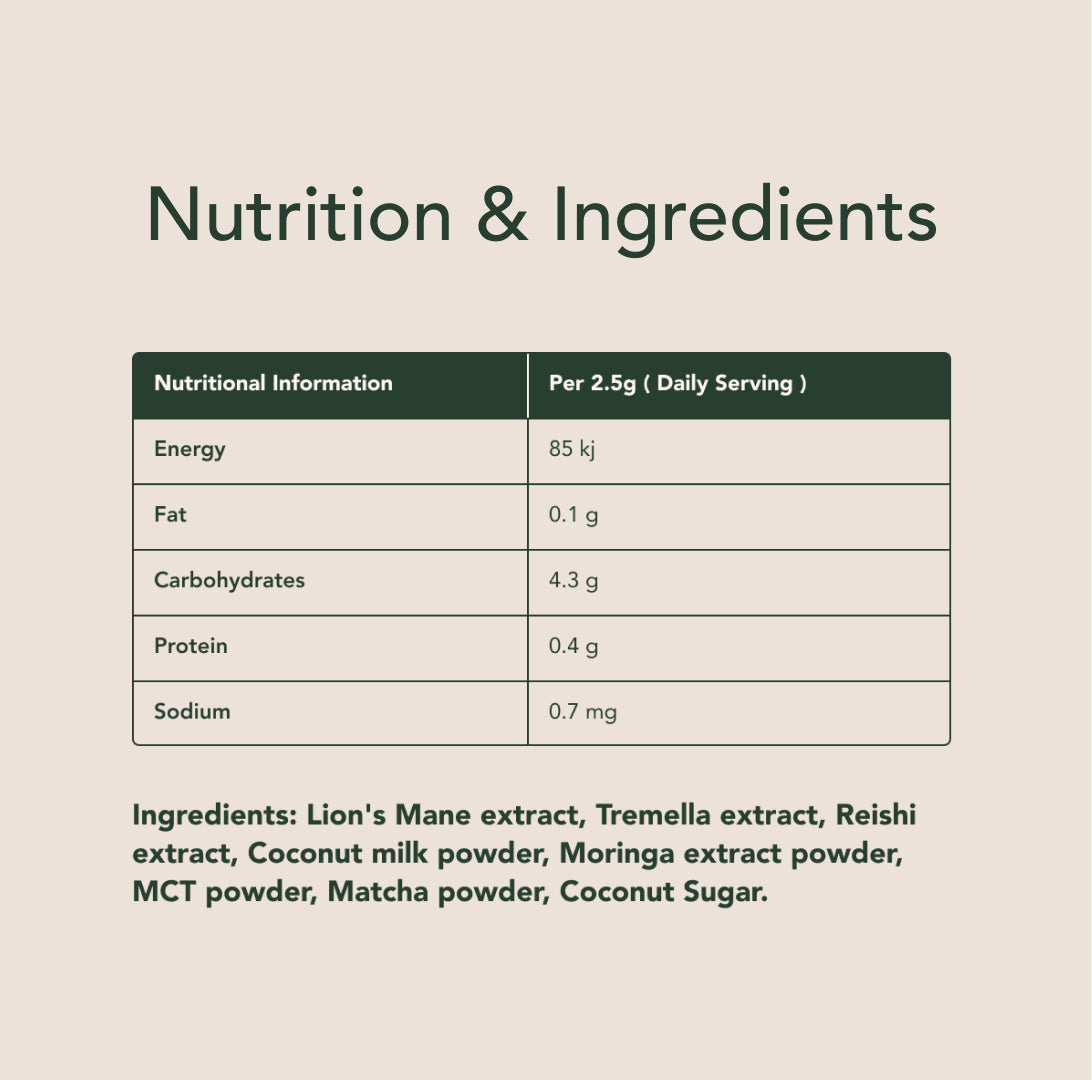
Reishi doesn't "boost" your immune system. It helps calibrate it — and that's exactly what most people need. At Nooni, Reishi is in the Mushroom Matcha and Mushroom Cacao, made from 100% fruiting bodies with dual extraction. No compromises on what's actually inside. Discover the products at getnooni.com.