
Your heart rate is no detail. It's a direct mirror of how your nervous system handles stress, recovery, and everything in between. Reishi — used for centuries in traditional Chinese medicine — contains a class of bioactive compounds that may influence exactly that system: triterpenes. Here's what the science says.
What is the autonomic nervous system?
The autonomic nervous system regulates everything your body does automatically. Breathing. Digestion. And heart rate.
It consists of two branches that constantly try to stay in balance:
- The sympathetic system — the accelerator. Active during stress, exertion, and alertness. Increases heart rate, speeds up breathing.
- The parasympathetic system — the brake. Active during rest and recovery. Lowers heart rate, promotes sleep and restoration.
When this balance becomes chronically disrupted — too much sympathetic, too little parasympathetic — it's called autonomic dysfunction. It shows up as fatigue, poor sleep, elevated resting heart rate, and heightened stress sensitivity.
What exactly are triterpenes?
Triterpenes are a group of fat-soluble bioactive compounds. They're found in plants, fungi, and some animals.
In Reishi (Ganoderma lucidum), more than 150 different triterpenes have been identified — also called ganoderic acids. They're responsible for the mushroom's characteristic bitter taste and why Reishi isn't simply eaten like a regular mushroom.
Ganoderic acids are only soluble in alcohol. That's precisely why a dual extraction — both water and alcohol — is essential for a fully active extract.
How do triterpenes influence heart rate?
ACE inhibition
Angiotensin-converting enzyme (ACE) plays a central role in blood pressure regulation. It converts angiotensin I to angiotensin II, a substance that narrows blood vessels and raises blood pressure.
Studies suggest that certain ganoderic acids from Reishi can inhibit ACE. This may contribute to lower peripheral vascular resistance, which indirectly reduces the workload on the heart.
Modulation of the parasympathetic system
Reishi extracts have traditionally been associated with calm and recovery. There is research — largely in animal studies — suggesting that triterpenes may support parasympathetic activity via GABAergic pathways.
GABA is the primary inhibitory neurotransmitter in the central nervous system. More GABA activity means less sympathetic overdrive: a lower resting heart rate, fewer cortisol spikes, better sleep quality.
The mechanism appears twofold: triterpenes may both support GABA receptor activity and slow GABA breakdown.
Heart rate variability (HRV)
Heart rate variability (HRV) is the variation in time between consecutive heartbeats. The higher your HRV, the more resilient your nervous system. HRV is seen as one of the best markers for autonomic balance and overall health.
There is preliminary evidence that adaptogen-rich extracts — including Reishi — may favorably influence HRV by strengthening parasympathetic activity. Large-scale human RCTs are still lacking, but the mechanistic logic is solid.
Adaptogenic action: systemic, not acute
Reishi doesn't work like caffeine or beta-blockers. There's no immediately measurable effect after a single dose.
Reishi is an adaptogen — a substance that helps the body find its own balance, depending on context. Under chronic stress exposure, that might mean a lower cortisol response. During underactivity: a milder stimulation of the immune system.
That makes Reishi fundamentally different from pharmacological interventions. It supports regulation instead of forcing a direction.
Traditionally, Reishi was recommended for long-term use — at least 4 to 8 weeks — to allow the adaptive effects to build.
Quality determines efficacy
Not every Reishi product delivers triterpenes. That's a crucial point.
Products made from mycelium on grain often contain little to no active ganoderic acids — the grain dilutes the final product and true fruiting bodies aren't used. Always choose:
- 100% fruiting bodies — the part of the mushroom that contains the highest concentration of bioactive compounds.
- Dual extraction — without alcohol extraction, triterpenes don't release into the extract.
- Third-party tested — so the concentration of beta-glucans and triterpenes are demonstrably present.
Reishi at Nooni
The Nooni Mushroom Matcha and Mushroom Cacao both contain Reishi, obtained via dual extraction from 100% fruiting bodies.
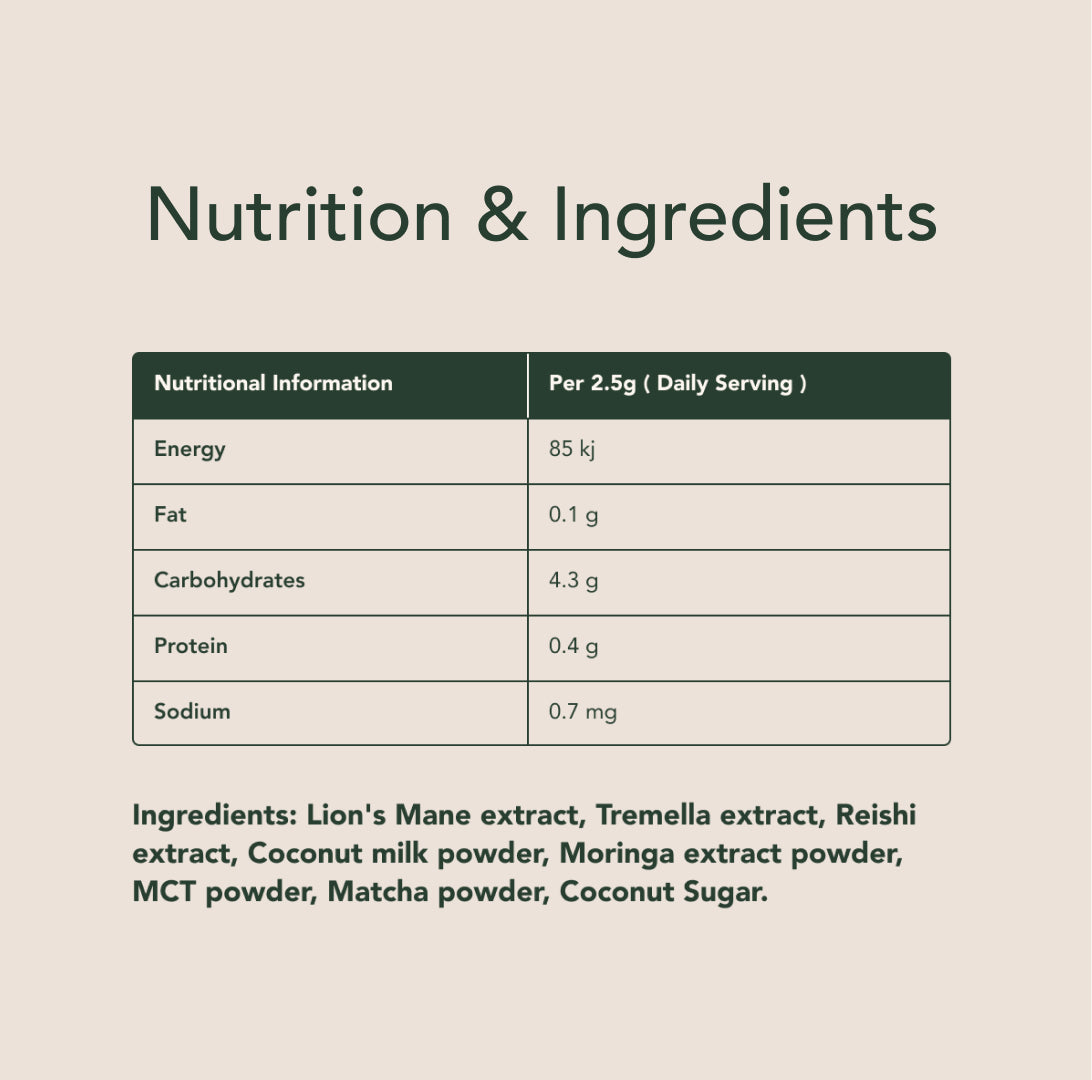
The Mushroom Matcha combines Reishi with Lion's Mane and Tremella — a formula aimed at vitality and immune support, with the calming foundation that Reishi provides.
The Mushroom Cacao places Reishi at its center as an evening formula. Cacao naturally contains theobromine and magnesium — both associated with smooth muscle relaxation and cardiovascular calm. Combined with Reishi's triterpenes, this is the formula that comes closest to supporting autonomic recovery.
Conclusion
The autonomic nervous system cannot be commanded. It responds to consistency, rest, and the right input over time. Reishi's triterpenes are no quick fix — they're a signal to a system that already knows what to do. Discover Nooni Mushroom Cacao and Mushroom Matcha on getnooni.com and give your nervous system something to fall back on.