
A good night begins long before you turn off the lights. Reishi — used for centuries in traditional Chinese medicine — can play a key role in how your body and mind wind down from the day. Here's how to build an evening routine where functional mushrooms become a natural part.
What reishi does to your nervous system
Reishi (Ganoderma lucidum) is an adaptogen. That means: it helps your body manage stress by regulating physiological processes — not suppressing or overstimulating them.
The interesting mechanism lies in reishi's triterpenes, specifically ganoderic acids. Studies suggest these compounds interact with GABA receptors in the brain. GABA is your primary inhibitory neurotransmitter: the substance that brings your nervous system to rest. Less GABA activity often means more rumination, more tension — and less deep sleep.
So reishi doesn't just support "relaxation". It works on a specific biochemical pathway directly connected to how quickly you fall asleep and how deeply you sleep.
The evening is a transition, not a switch
The biggest mistake people make? They try to jump from 100% on to 0%. A meeting at 9 p.m., scrolling until midnight, then expecting sleep to arrive naturally.
Your nervous system doesn't work like a light switch. It needs time to shift from the sympathetic state — active, alert, cortisol — to the parasympathetic state. That's the state of rest and recovery.
An evening routine isn't a luxury. It's physiology.
Hour 1: Winding down (8 p.m.–9 p.m.)
Start by reducing stimuli. Dimmed lights, no new work, less screen time. This is also when you plan your reishi moment.
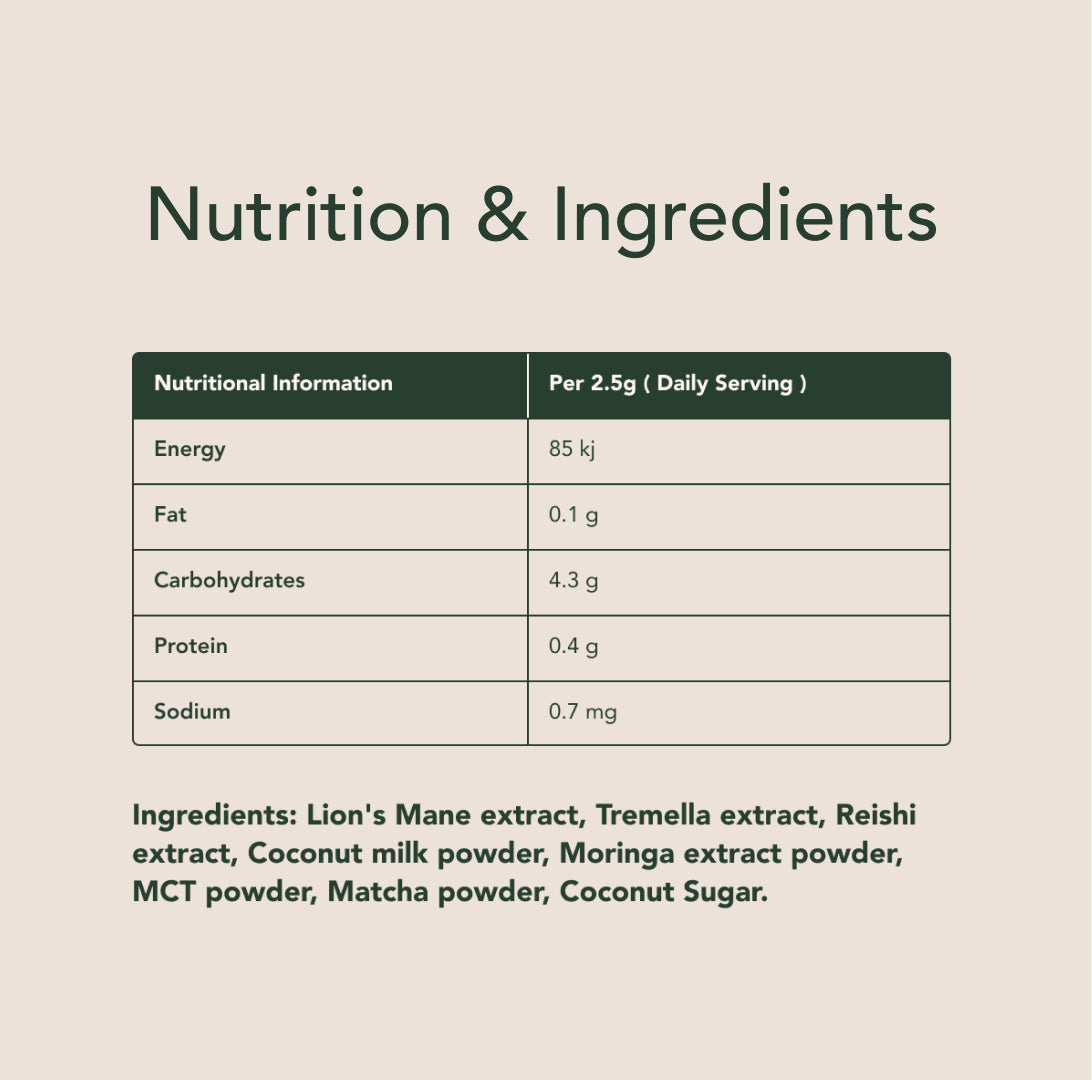
Nooni's Mushroom Cacao combines Tremella, Lion's Mane, and Reishi. The warm cacao itself has a ritualistic quality — holding something warm, drinking slowly — that already contributes to the parasympathetic shift. But the reishi is working at the cellular level meanwhile.
Tremella also supports skin hydration overnight, the period when skin repair peaks.
Hour 2: Deepening (9 p.m.–10 p.m.)
Now that your body is beginning to cool and melatonin is rising, it helps to deepen the routine. Think breathing exercises, reading, or a short walk.
No large meals anymore. No caffeine — not even in the form of green tea or matcha. Your digestion demands energy; you want to direct that energy toward recovery now.
This is also the hour when you can start feeling reishi's effects. Not as drowsiness, but as a subtle reduction in mental noise. Fewer thoughts demanding attention.
Hour 3: Surrender (10 p.m.–11 p.m.)
Your body is ready. Your environment too — cool, dark, quiet. This is when reishi's support of GABA activity becomes most relevant.
Studies suggest reishi can extend total sleep time and positively influence the amount of deep, non-REM sleep. That's the sleep phase where physical recovery happens: muscle repair, hormone regulation, cell renewal.
Why extract quality matters here
Not all reishi is equal. This is the part most brands skip over.
Reishi's active compounds fall into two groups:
- Beta-glucans — polysaccharides that modulate immune function. Water-soluble.
- Triterpenes (ganoderic acids) — the compounds that interact with GABA pathways. Alcohol-soluble.
A standard water extract pulls out only the beta-glucans. If you want the full profile — including the triterpenes relevant for relaxation and sleep — you need a dual extraction: water first, then alcohol.
Nooni uses only dual extraction from 100% fruiting bodies. No mycelium on grain, which dilutes the active content significantly in many cheaper products. Every batch is third-party tested for active compounds and contaminants.
Functional mushrooms throughout the day: context for evening
Your evening routine doesn't exist in isolation from the rest of your day. How you function during the day partly determines how your body unwinds in the evening.
A day that begins with Lion's Mane — for focus and cognitive clarity — and ends with Reishi, follows a logical physiological curve. Stimulate where needed, calm where appropriate.
Functional mushrooms work best as a system, not as isolated interventions.
What to expect
Reishi is not a sleeping pill. The effects are subtle and cumulative. Most people describe it as:
- Easier to let go of thoughts before sleep
- Less waking in the middle of the night
- Waking fresher without the sleep lasting longer
That last one is telling. Sleep quality isn't only about hours. It's about the ratio of deep sleep, REM, and light sleep. Reishi may influence the distribution — not the clock.
Give it two to four weeks. Adaptogens build up. They're not a quick fix, and that's precisely why they work.
Conclusion
An evening routine with reishi isn't a ritual for people with spare time. It's a choice about how you guide the transition from day to night — with something that biochemically supports what your body is already trying to do. Nooni's Mushroom Cacao is designed for exactly this moment. Discover it at getnooni.com.