
Your immune system is making a mistake. It treats an innocent pollen or food protein as an invader — and deploys histamine as a weapon. Reishi can shift that conversation. Not by shutting down your immune system, but by recalibrating it.
What histamine actually does
Histamine is not an enemy. It's a signaling molecule your immune system uses to sound an alarm. Against a real threat — a bacterium, a wound — that response is useful. In someone with an allergy, the system sounds an alarm at something that is actually harmless.
The result is familiar: sneezing fits, itchy eyes, skin rash, breathing problems. Your body mounts a defense that wasn't needed at all.
The core of the problem lies with mast cells — specialized immune cells that store histamine and release it massively when activated. The faster they respond, the more severe the symptoms.
What immunomodulation means
Immunomodulation is not a word meant to impress. It describes literally what it is: modulating — adjusting, recalibrating — the immune response.
That's fundamentally different from immunosuppression. Antihistamines block histamine receptors after the reaction has already been triggered. They dampen the effect. Immunomodulation tries to influence the system earlier in the process.
Reishi works primarily via this second path.
How Reishi affects the immune system
Beta-glucans and immune response
The most studied active compounds in Reishi are beta-glucans — polysaccharides that bind to receptors on immune cells, including macrophages and Natural Killer cells. This activates a coordinated immune response without overdoing the inflammatory cascade.
Studies suggest that beta-glucans can influence the balance between Th1 and Th2 immune responses. In allergic conditions, the Th2 response is typically overactive — this is precisely the branch that drives mast cells and stimulates histamine production. A shift toward Th1 can potentially dampen that overreaction.
Triterpenes and mast cell stabilization
Reishi also contains triterpenes — bitter, fat-soluble compounds that laboratory research suggests can inhibit mast cell degranulation. Degranulation is the moment when mast cells release histamine. Less degranulation means less histamine in circulation.
Ganoderic acid, one of the most studied triterpenes in Reishi, appears to play a role here by blocking certain enzymes in mast cell activation. The studies are promising, but largely in vitro — clinical trials in humans are still limited.
What extraction method has to do with this
Not all Reishi is created equal. This is where quality becomes practically relevant.
Beta-glucans are water-soluble. Triterpenes are not — they require alcohol extraction. A product that uses only hot water misses the triterpenes. A product that uses only alcohol misses the beta-glucans.
Dual extraction — first water, then alcohol, or vice versa — is the only way to fully extract both compound groups. That's also why the extraction method on the label says something about the product's quality.
It also matters whether the product is made from the fruiting body of the mushroom or from mycelium on grain. Fruiting bodies contain significantly higher concentrations of active compounds. Mycelium on grain contains mostly starch — with little to no therapeutic effect.
What the science says — and what it doesn't
Reishi and allergies is an active area of research, but honesty belongs here.
Animal studies and in vitro research show consistent results: less mast cell activation, lower histamine levels, better Th1/Th2 balance. Human clinical trials exist, but are small-scale. The effects are promising, not proven.
What is broadly accepted: Reishi has a strong immunomodulatory profile. Studies suggest it works as an adaptogen — it calms the system where it's overactive, and stimulates where it underperforms. For allergic reactions, where overactivation is the core problem, that mechanism fits logically into the picture.
It's not a replacement for medical treatment. But as a supplement, or as a way to structurally recalibrate your immune system, the rationale is solid.
Reishi in practice
When do you notice something?
Immunomodulation doesn't work like an antihistamine. Don't expect an effect within an hour. The mechanisms Reishi influences — immune cell differentiation, mast cell sensitivity — shift gradually with consistent use. Most users report subtle shifts after four to eight weeks.
Which product?
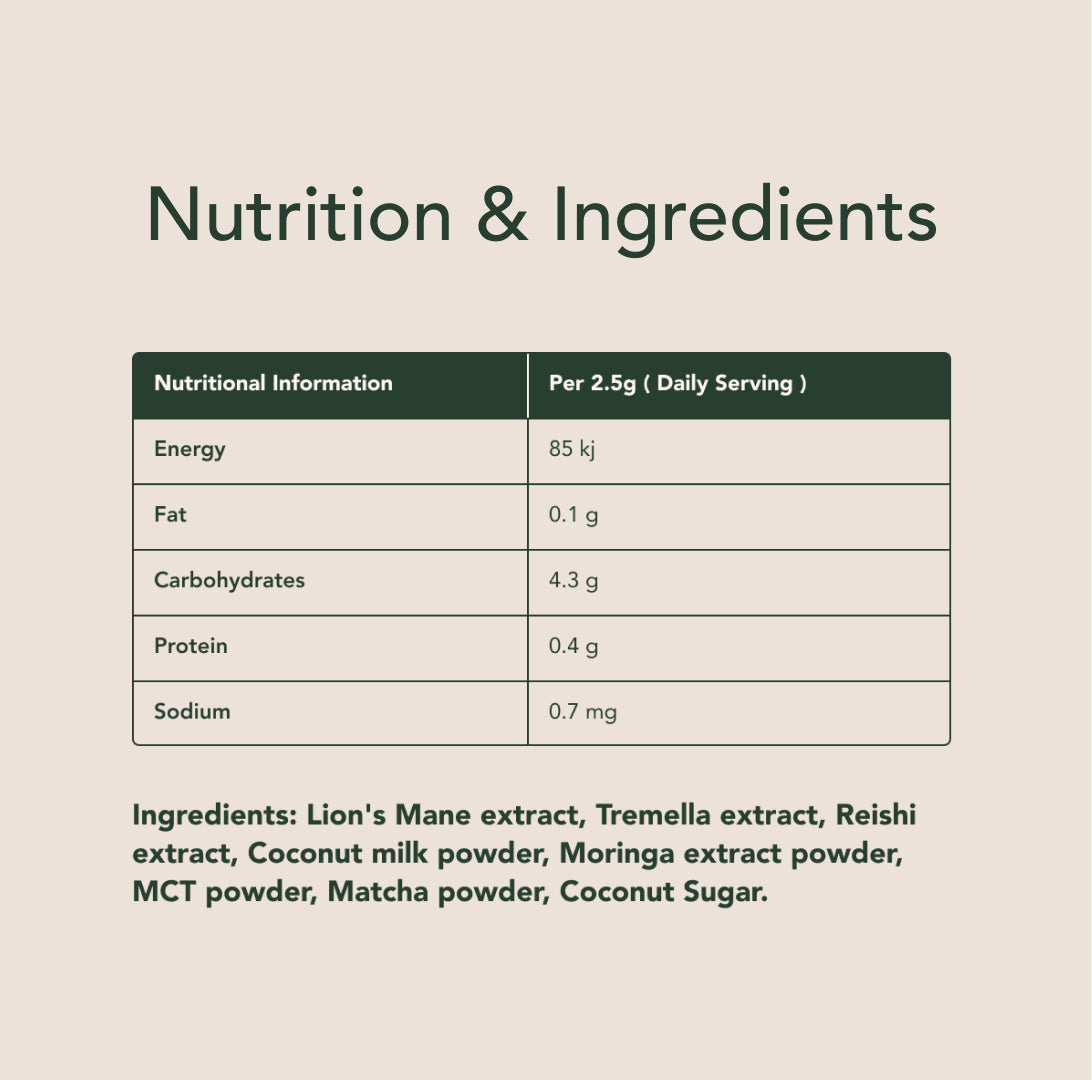
Nooni's Mushroom Matcha combines Reishi with Lion's Mane and Tremella. For those focusing specifically on calm, recovery, and immune support, Mushroom Cacao is a better fit — with Tremella and Lion's Mane complementing the Reishi profile. Both products use dual extraction from 100% fruiting bodies.
Combining it with medication?
If you're taking immunosuppressants or specific allergy medication: discuss it with a doctor. Reishi is generally well tolerated, but interactions are possible with certain medication categories.
Conclusion
Allergies are not a weakness of the immune system. It's a system set too sensitively. Reishi offers no quick fix, but the science behind immunomodulation — mast cell stabilization via triterpenes, Th1/Th2 balance via beta-glucans — makes it a serious addition to a daily routine. Discover Nooni's Reishi products at getnooni.com.