
Stress is not a feeling — it's a physiological process. Your body responds to pressure with a hormonal cascade that, with chronic exposure, takes its toll. Adaptogens like Reishi can influence that cascade. Not by removing stress, but by helping your body handle it better.
What is an adaptogen?
An adaptogen is a natural substance that helps your body adapt to stress — physical, mental, or emotional. The name comes from the verb adapt: to adjust.
But not every plant or mushroom can call itself an adaptogen. There are three scientific criteria a substance must meet:
- Non-specific: it works on multiple stressors at once, not on one specific problem.
- Normalizing: it brings physiological processes into balance — up or down, depending on what your body needs.
- Harmless: it causes minimal side effects at normal dosing.
Reishi (Ganoderma lucidum) meets all three. It's one of the best documented adaptogens in the world.
How stress affects your body
To understand what Reishi does, you first need to understand what stress does to your body.
When faced with a stressor — a deadline, a conflict, sleep deprivation — your body activates the HPA axis: the hypothalamic-pituitary-adrenal axis. This system directs the production of cortisol, your primary stress hormone.
Short-term cortisol is functional. It increases alertness, mobilizes energy, and sharpens your reactions. The problem emerges with chronic activation. Then cortisol stays elevated, and that has consequences: poor recovery, disrupted sleep, a suppressed immune system, and an overtaxed nervous system.
Adaptogens intervene in this system. They modulate the HPA axis, keeping the stress response proportional.
Reishi and the stress response system
Reishi contains two groups of active compounds central to this story: beta-glucans and triterpenes — particularly ganoderic acids.
Beta-glucans
Beta-glucans are complex polysaccharides that modulate the immunological stress response. They bind to receptors on immune cells and help calibrate the system — not stimulate, not suppress, but balance.
This is exactly what an adaptogen does: it normalizes, rather than pushing in one direction.
Triterpenes and ganoderic acids
Ganoderic acids are bitter triterpene compounds unique to Reishi. They have a molecular structure that resembles steroid hormones — and that's no accident.
Studies suggest that ganoderic acids can modulate the HPA axis by dampening the cortisol response without blocking it entirely. They work on the stress receptors of the central nervous system and can support the shift from a sympathetic (fight-or-flight) to a parasympathetic (rest-and-recover) state.
Reishi and GABA
A third mechanism works through the GABA system. GABA is the brain's primary inhibitory neurotransmitter — it restrains neuronal activity and has a calming effect.
Research suggests that certain compounds in Reishi can support GABA activity. This partly explains why Reishi has traditionally been used for sleep issues and mental restlessness.
What adaptogens are not
Adaptogens are not sedatives. They don't make you sleepy during the day or numb to stimuli. The effect is subtler: you experience the same stressors, but your body responds to them more proportionally.
They're also not a quick fix. Most studies showing positive effects work with consistent use over several weeks. Adaptogens build a physiological buffer — that takes time.
And they don't replace sleep, movement, or healthy eating patterns. They support a body that already has a foundation.
Dual extraction: why it matters
Not all Reishi is equivalent. Beta-glucans are water-soluble and are released through hot water extraction. Triterpenes — including the ganoderic acids — are fat-soluble and require alcohol extraction.
A product extracted only with water misses a significant portion of the active compounds. Dual extraction — water and alcohol — is the only way to capture the full spectrum.
Nooni uses exclusively dual extraction. And exclusively fruiting bodies, not mycelium on grain. Mycelium contains significantly fewer beta-glucans and a higher concentration of starch — a filler with no adaptogenic value.
Who is Reishi relevant for?
Reishi is not a product for one specific type of person. But there are circumstances where the support it can offer is relevant:
- Chronic mental strain: heavy screen time, high cognitive load, few recovery moments.
- Disrupted sleep: difficulty falling or staying asleep, waking without a sense of restoration.
- Immune system under pressure: periods of illness, seasonal transitions, exhaustion.
- Transition from active to rest: for people who struggle to "switch off" after a busy day.
Studies suggest that Reishi can play a supporting role in all these contexts. It's not a treatment. It's a tool for people who want to optimize their baseline condition.
Reishi at Nooni
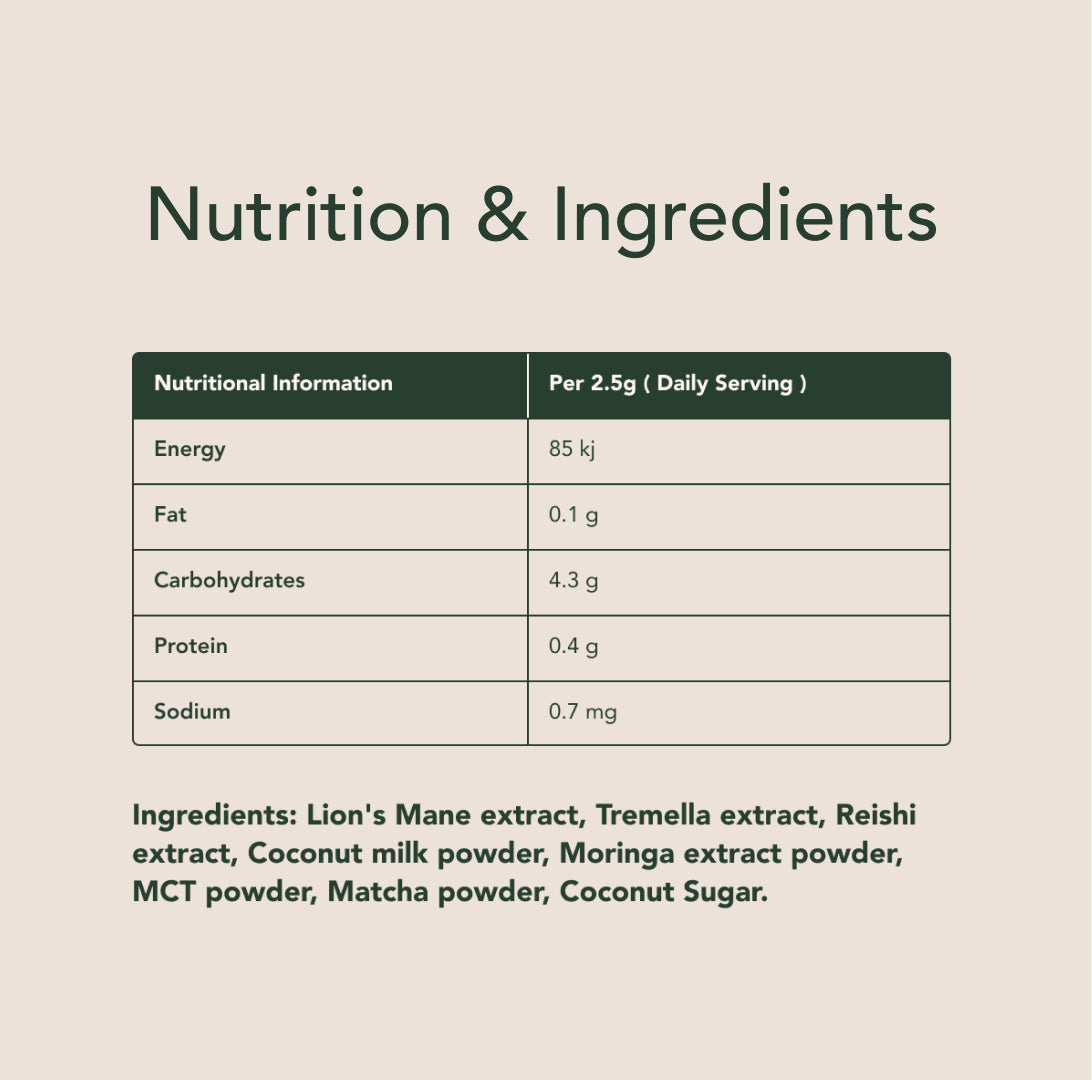
Reishi is present in two Nooni products: the Mushroom Matcha and the Mushroom Cacao.
The Mushroom Cacao is formulated with evening use in mind. Alongside Reishi, it contains Tremella and Lion's Mane — a combination aimed at relaxation, recovery, and sleep quality. A warm cup of cacao as a bedtime ritual. Without sugar. Without caffeine.
The Mushroom Matcha combines Reishi with Lion's Mane and Tremella for daytime use — focused on vitality and productivity, with the calming balance that Reishi adds to matcha's natural caffeine.
Conclusion
Reishi doesn't work like a switch. It works like a buffer — built over time, felt in how you respond to what your day brings. Discover the Mushroom Cacao or Mushroom Matcha on getnooni.com and experience what consistency does.