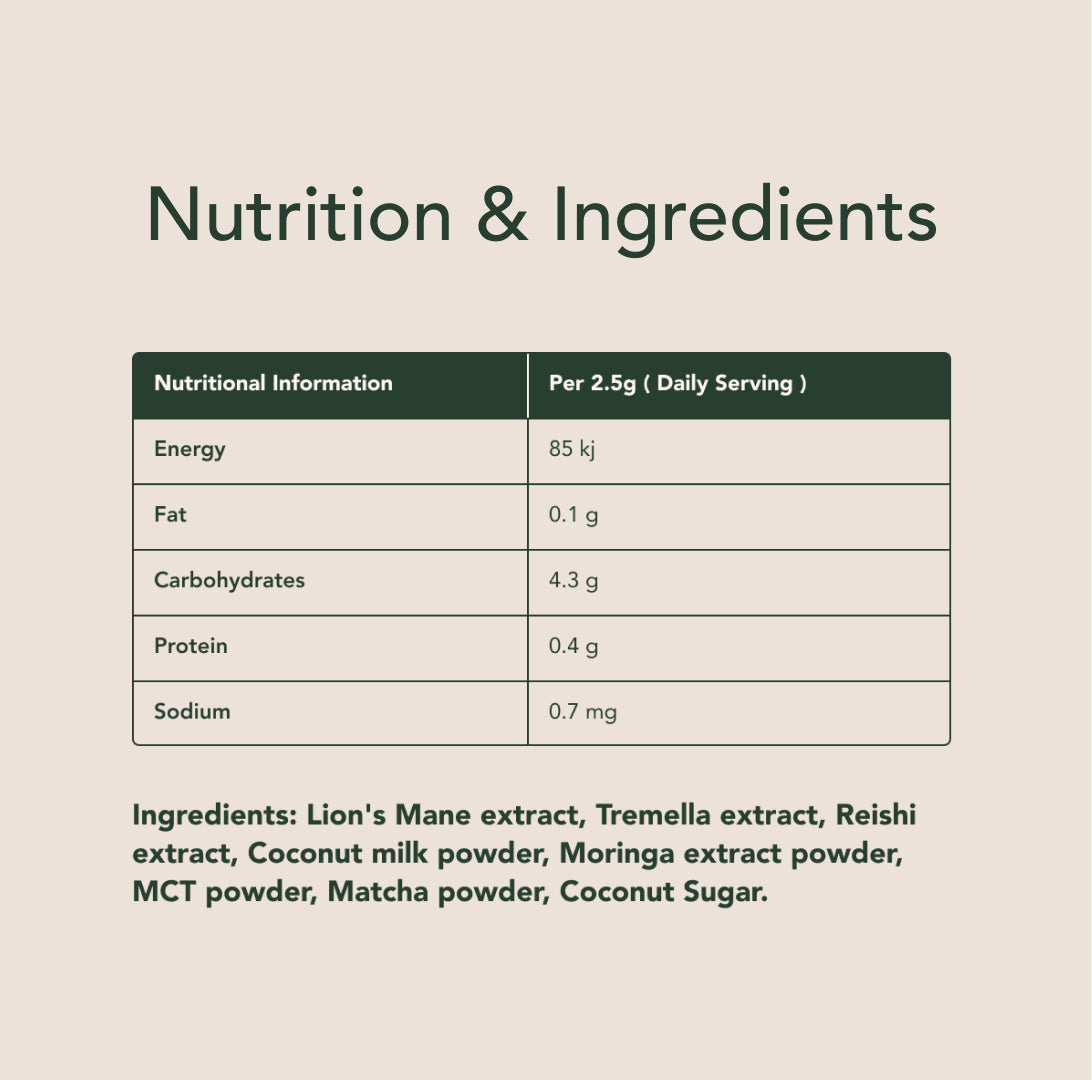

Matcha already has a solid reputation. Calm energy, sharp focus, no crash. Functional mushrooms like Reishi and Lion's Mane do something similar — but deeper, and through different mechanisms. Combine them, and they amplify each other in ways neither achieves alone.
Why matcha is already different
Matcha is not ordinary tea. The leaves are shade-grown before harvest, which raises the L-theanine content. L-theanine is an amino acid that crosses the blood-brain barrier and stimulates the production of alpha brain waves — the type of brain activity you associate with calm concentration.
Combined with the caffeine in matcha, something emerges that's rare elsewhere: alertness without restlessness. No peaks. No crashes. It's why matcha has been the drink of both meditation and discipline for centuries.
But matcha does little for your immune system, your sleep, or your nervous system over the long term. That's where the mushrooms come in.
Lion's Mane: focus from within
Lion's Mane — the lion's mane mushroom — works on a fundamentally different level than caffeine or L-theanine. It stimulates the production of NGF (Nerve Growth Factor) and BDNF (Brain-Derived Neurotrophic Factor). These are proteins that support the growth, repair, and maintenance of nerve cells.
Concretely: studies suggest that Lion's Mane can support the myelin sheath — the protective layer around your nerve fibers that determines signal speed. Better myelin means faster processing. Less brain fog. Better retention.
Where matcha makes you alert right now, Lion's Mane works more like an investment in your cognitive capacity over time. The combination offers both immediate sharpness and long-term support.
What you'll actually notice
Not "better focus" as an abstract concept. Rather: you read a paragraph and understand it immediately. You don't need to scroll back. The thought you lost is still there.
Reishi: the counterbalance
Reishi is the adaptogen par excellence. While Lion's Mane activates the nervous system, Reishi brings balance. It influences GABA receptors — the same receptors involved in relaxation and sleep.
That might sound contradictory in a morning drink. But adaptogens don't work like sedatives. They support your stress response: they help your body return to homeostasis when cortisol rises. The result isn't sluggishness, but stability.
Reishi also contains beta-glucans — complex polysaccharides that modulate the immune system. Not stimulate or suppress, but regulate. That distinction matters.
Reishi and productivity
Elevated cortisol impairs your working memory. Studies suggest that chronic stress literally shrinks the prefrontal cortex — the part of your brain that makes planning, deciding, and focusing possible. Reishi supports the dampening of that stress response. Less cortisol noise means more room for clear thinking.
Tremella: support from within
Tremella is known as the beauty mushroom, but its effects go deeper than skin. Tremella contains polysaccharides with a hydrating effect similar to hyaluronic acid — they attract water and hold it, both in skin and in tissues.
In the context of a daily routine: cellular-level hydration supports brain function, energy metabolism, and recovery. Dry cells are less efficient cells.
Tremella also contributes to collagen production and has antioxidant properties that neutralize free radicals. No dramatic claims — but a solid, quiet contribution to how you feel and look.
The combination: why it works
Matcha + Lion's Mane + Reishi + Tremella is not random stacking. Each ingredient works through a different mechanism, on a different system:
- Matcha (L-theanine + caffeine) → immediate, calm alertness
- Lion's Mane (NGF/BDNF) → cognitive support and nerve health
- Reishi (triterpenes + beta-glucans) → stress regulation and immune balance
- Tremella (polysaccharides) → hydration, antioxidant, recovery
No overlap. No redundancy. Each ingredient fills a different gap.
Extraction: why quality makes the difference
Functional mushrooms contain two groups of bioactive compounds: beta-glucans (water-soluble) and triterpenes (fat-soluble). Single water extraction — as with most mushroom powders — only pulls beta-glucans.
Dual extraction combines water extraction and alcohol extraction. This makes both compounds available. That's the difference between a mushroom in your drink and a mushroom that actually does something.
Additionally: 100% fruiting bodies, no mycelium on grain. Mycelium on grain contains mostly starch — and hardly any of the bioactive compounds that matter. Fruiting bodies are the part of the mushroom that delivers the active concentrations.
How to use it
Mushroom Matcha dissolves easily in warm water or plant-based milk. Whisk it for a latte-like texture. Combine it with oat milk for something creamy. Or dissolve it in cold water if you're in a hurry.
It works best as a daily habit. Not as a quick fix. Adaptogen effects build over weeks — the sensory experience is immediate, the deeper effects follow.
Timing: morning or early afternoon. Reishi supports relaxation, but the caffeine in matcha makes late consumption less ideal for sensitive sleepers.
Conclusion
Matcha was already strong. Add Lion's Mane, Reishi, and Tremella — via dual extraction, from 100% fruiting bodies — and you have a morning drink that works on multiple levels at once. Calm energy. Cognitive support. Immune balance. Everything you need for a productive day, without the noise. Find Nooni Mushroom Matcha at getnooni.com.