
Matcha and Lion's Mane seem like an unlikely pairing at first. Yet the combination is anything but random. Where matcha sharpens your mind through caffeine and L-theanine, Lion's Mane works deeper — at the level of your nervous system itself.
What regular green tea does
Green tea contains caffeine and L-theanine. These two compounds work together: caffeine delivers alertness, L-theanine softens the sharp edges. The result is calm focus — without the spike and crash of coffee.
Matcha goes further. It's a concentrated form of green tea: you drink the whole leaf, not just the extract. That means more L-theanine, more antioxidants, and a steadier energy level throughout the day.
But matcha has one blind spot. It supports your alertness in the moment. What it doesn't do is contribute to your brain's structural capacity over the longer term.
What Lion's Mane adds
Lion's Mane — scientifically Hericium erinaceus — works on a different level. The mushroom stimulates the production of NGF: Nerve Growth Factor. That's a protein that drives the growth and maintenance of nerve cells.
Simply put: NGF keeps your neurons healthy and promotes the formation of new connections. Studies suggest Lion's Mane also supports BDNF — Brain-Derived Neurotrophic Factor — a substance that influences learning and memory.
Where matcha activates your brain, Lion's Mane helps build it. That's the difference.
The synergy: focus and foundation
The strength of this combination lies in its complementarity. Matcha delivers immediate sharpness. Lion's Mane works on the underlying infrastructure.
It's the difference between good headlights and good pavement. Both alone are useful. Together they determine how far and how smoothly you travel.
L-theanine — present in matcha — may also enhance the absorption of bioactive compounds. This combination isn't a marketing story. It's functional logic.
How Lion's Mane actually works
The active compounds in Lion's Mane are hericenones and erinacines. Hericenones are found in the mushroom's fruiting body. Erinacines in the mycelium. Both stimulate NGF synthesis, but through different mechanisms.
That's also why extraction method matters. Dual extraction — with both water and alcohol — pulls both types of compounds from the fruiting body. A water-only extract isn't sufficient. Capsules based on mycelium grown on grain typically contain little to no active compounds.
For your brain, that makes a measurable difference.
Brain fog: what's actually happening
Brain fog isn't an official diagnosis. But the experience is real: sluggish thoughts, difficulty concentrating, the feeling that your brain won't cooperate.
Chronic stress, sleep deprivation, and inflammatory processes are commonly cited causes. Lion's Mane can support these processes through its neuroprotective action. Studies suggest that regular use contributes to mental clarity — not as a quick fix, but as consistent support over time.
Energy without the crash
Matcha naturally has less caffeine than coffee. Combined with the calming effect of L-theanine, it creates a flatter energy curve. No spike at 9 a.m. and no crash at 2 p.m.
Lion's Mane has no direct effect on caffeine. What it does do is contribute to cognitive resilience — the ability to keep thinking clearly under pressure or when tired.
Matcha vs. green tea: the practical difference
Matcha isn't tea in the classical sense. With green tea, you discard the leaf. With matcha, you drink it. That significantly changes the concentration of active compounds.
Compared to a standard cup of green tea, matcha contains:
- Significantly more L-theanine
- More chlorophyll
- Higher antioxidant density (measured via ORAC value)
For those drinking green tea for its benefits: matcha is the more efficient choice. And matcha with Lion's Mane is one step further still.
Reishi and Tremella: the rest of the picture
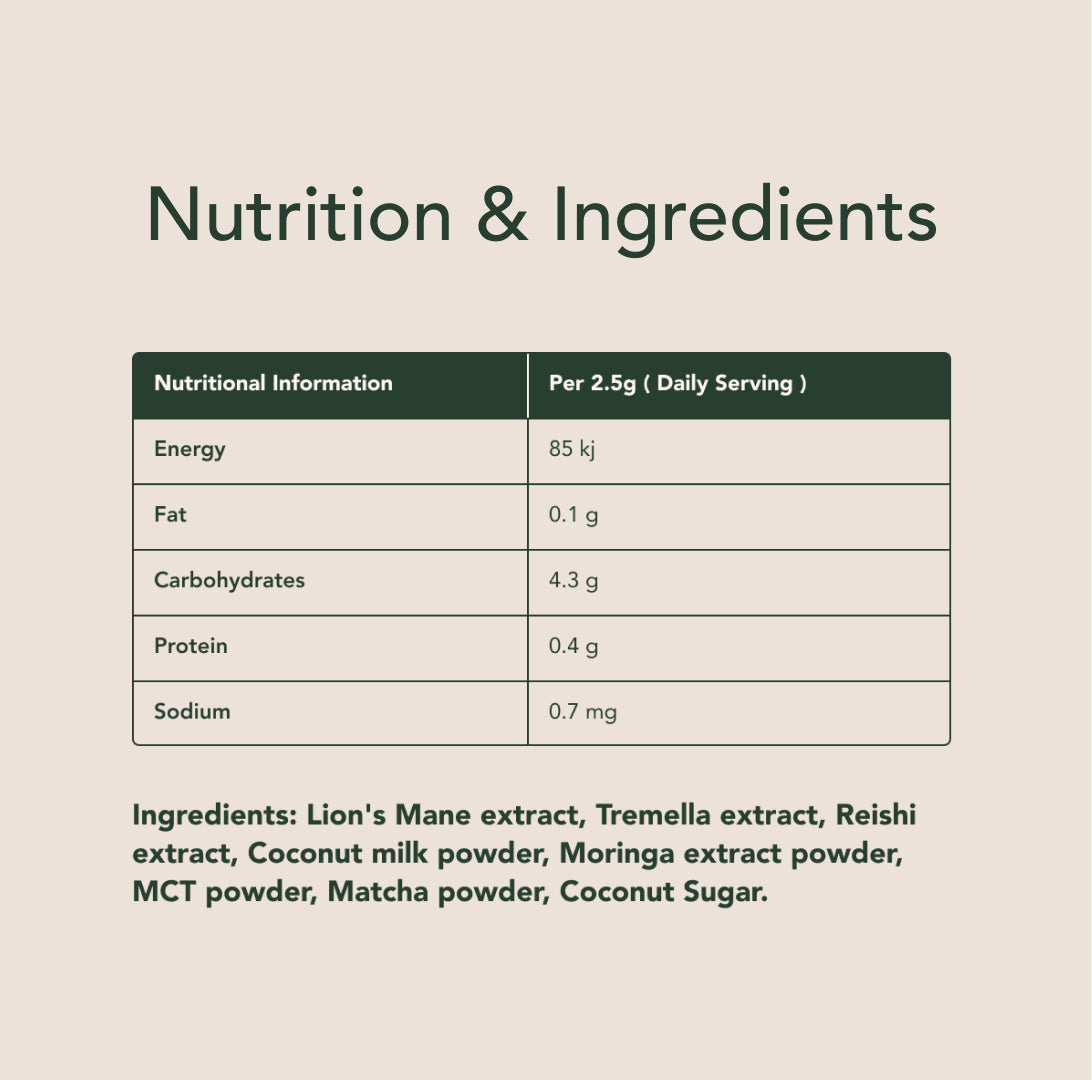
Nooni's Mushroom Matcha combines Lion's Mane not only with matcha, but also adds Reishi and Tremella.
Reishi is a powerful adaptogen. It helps your body manage stress — not by eliminating stress, but by regulating the physiological stress response. Traditionally used for calm and recovery.
Tremella is known as the beauty mushroom. The polysaccharides in Tremella work in a way comparable to hyaluronic acid: they bind moisture and support skin hydration from within. A subtle benefit, but a real one.
Together they form a stack that's widely applicable: focus, resilience, recovery, and hydration in one cup.
How to prepare it best
Matcha is best prepared with water between 70 and 80 degrees Celsius. Boiling water damages the tea catechins and makes the taste bitter.
Whisk it thoroughly with a bamboo matcha whisk or milk frother. Add plant-based milk if you want a latte. The mushroom extracts dissolve well — they barely change the taste.
Consistency determines the result. Lion's Mane works cumulatively. You might notice one cup already. After thirty days you'll certainly notice it.
Conclusion
Matcha gives you focus. Lion's Mane builds the foundation that focus rests on. The combination is no accident — it's functional synergy. Want to experience it yourself? Nooni's Mushroom Matcha contains Lion's Mane, Reishi, and Tremella in dual-extracted form, made from 100% fruiting bodies. Discover it at getnooni.com.