
Lion's Mane is not a trend mushroom. It's one of the most researched functional mushrooms in the world — specifically because of its effects on the brain. What science shows about focus, memory, and long-term cognitive performance is nuanced, promising, and worth understanding.
Why Lion's Mane is different
Most things that promise "focus" work through stimulation. Caffeine blocks adenosine receptors. Synthetic nootropics temporarily increase neurotransmitter activity. Lion's Mane works more fundamentally — not by making your brain work harder, but by supporting its infrastructure.
The active compounds are called hericenones and erinacines. They stimulate the production of Nerve Growth Factor (NGF) and Brain-Derived Neurotrophic Factor (BDNF). These are proteins responsible for the growth, maintenance, and protection of neurons. Low NGF means slower recovery, less plasticity, and over time: brain fog.
NGF: the building block of your brain
NGF is not a trendy acronym. It's a crucial protein, discovered in the nineteen-fifties by neuroscientist Rita Levi-Montalcini — a discovery that won her the Nobel Prize. Without sufficient NGF, neurons lose their ability to form and maintain connections.
Lion's Mane is currently the only known edible mushroom that can demonstrably stimulate NGF production. Erinacines — the lipophilic compounds in the fruiting body — are small enough to cross the blood-brain barrier. This makes them biologically relevant at the brain level.
What studies show
A widely cited randomized, double-blind, placebo-controlled study from Japan (Mori et al., 2009) showed that participants who took Lion's Mane for 16 weeks scored significantly better on cognitive function tests than the placebo group. After stopping, the effect gradually disappeared — suggesting that consistency is essential.
A more recent study (Lai et al., 2013) showed that erinacines stimulate BDNF production, a protein closely linked to learning and memory formation. BDNF is also called the "growth hormone of the brain" — it supports neuroplasticity, the brain's ability to adapt.
What this means for focus
Focus is not an isolated mechanism. It's the outcome of multiple systems working well together: working memory, attention regulation, processing speed, emotional regulation. A brain with sufficient NGF and BDNF simply has better conditions.
Studies suggest Lion's Mane may contribute to:
- Less brain fog — the feeling of mental haziness that undermines concentration
- Improved working memory — the ability to actively hold information during a task
- Faster information processing — not thinking harder, but more efficiently
None of these effects are acute. Lion's Mane is not espresso. Science consistently points to effects that build over weeks to months of consistent use.
The role of myelin sheath
Less discussed, but equally relevant: Lion's Mane supports myelin sheath health. This is the protective layer around nerve fibers — like insulation around an electrical cable. An intact myelin sheath enables faster and more reliable signal transmission between neurons.
Research in animal models (Kolotushkina et al., 2003; Ryu et al., 2018) suggests that erinacines can promote remyelination. What this means for healthy people over the long term requires further human research — but the mechanism is telling.
Neuroprotection over the long term
This brings us to the most researched long-term perspective: neuroprotection. Multiple studies examine whether Lion's Mane may play a role in slowing age-related cognitive decline. The findings are cautiously positive.
Studies suggest Lion's Mane can reduce oxidative stress in brain cells and dampen neuroinflammation — two factors strongly associated with cognitive decline in later life. This is not about a miracle cure, but a serious functional mushroom with a scientifically grounded mechanism of action.
Dosing and quality
Studies that found significant effects typically worked with daily doses between 500mg and 3,000mg of dried fruiting body extract. But dosing only matters if the extract quality is right.
Two factors determine Lion's Mane effectiveness:
Fruiting body versus mycelium on grain Hericenones are found primarily in the mushroom's fruiting body. Products based on mycelium grown on grain often contain more starch than active compounds. The difference is not semantic — it's functional.
Extraction method Beta-glucans — the immunomodulating polysaccharides — are water-soluble. Triterpenes are fat-soluble. A dual extraction (water and alcohol) is needed to make the full spectrum of active compounds available. A single water extract misses part of the profile.
When to expect results
Based on existing research, a guideline: expect four to eight weeks of consistent use for noticeable cognitive effects. Some people report changes earlier — less brain fog, slightly sharper focus — but structural benefits for memory and neuroplasticity take time.
That's precisely what sets Lion's Mane apart from stimulants. It builds something. It doesn't deplete anything.
Combining with other adaptogens
Lion's Mane works well as a standalone supplement, but most interventions in research and practice combine it with other functional mushrooms. Chaga adds antioxidant support — relevant because oxidative stress undermines cognitive performance. Reishi supports sleep quality via GABA pathways, and good sleep is the most underrated factor for daytime cognition.
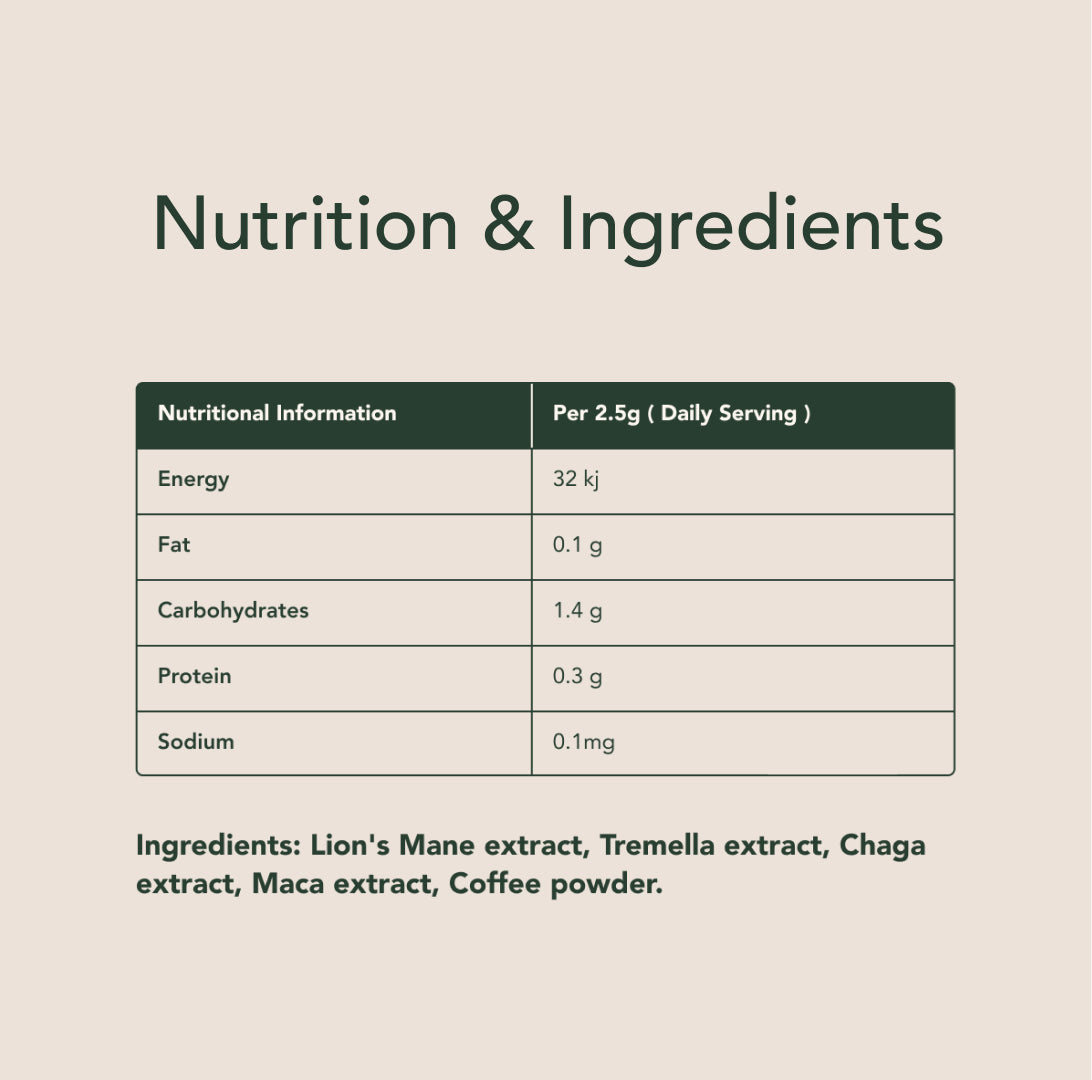
The combination of Lion's Mane with Chaga and Tremella — as in the Nooni Mushroom Coffee — is therefore not random. Focus is not only what you do during the day. It's also what your body recovers at night.
Conclusion
Science on Lion's Mane and cognitive performance is still developing, but the mechanism is clear: NGF, BDNF, myelin support, and neuroprotection are not marketing terms — they're measurable biological processes. If you want to support brain performance over the long term, it starts with the quality of what you take. Discover Nooni Mushroom Coffee at getnooni.com — with 450mg Lion's Mane per serving, dual-extracted from 100% fruiting bodies.