
Oxidative stress isn't an abstract concept — it's daily wear and tear at the cellular level. Chaga has the highest antioxidant value ever measured among all functional mushrooms in any food. Here's what the science actually shows.
What is oxidative stress?
Every cell in your body produces energy. That process leaves behind byproducts: free radicals. These are molecules with an unpaired electron — chemically unstable, searching for balance. They find it by stealing electrons from neighboring molecules. Those neighboring molecules become unstable themselves. This creates a chain reaction.
That process is called oxidation. In small amounts, it's normal and functional. The problem starts when free radical production exceeds what your body can neutralize. That's when we call it oxidative stress.
Oxidative stress plays a role in accelerated cellular aging, chronic low-grade inflammation, and the breakdown of cellular structures like DNA, proteins, and membranes. Long-term exposure — from poor sleep, ultra-processed food, air pollution, or chronic stress — noticeably speeds up that process.
How do you neutralize free radicals?
Antioxidants. They donate an electron to a free radical without becoming unstable themselves. This breaks the chain reaction. Your body makes them on its own — glutathione is the most well-known example — but external sources play a supporting role.
The standard measure for antioxidant capacity is the ORAC value: Oxygen Radical Absorbance Capacity. The higher the score, the more free radicals a substance can neutralize per gram.
Why Chaga ranks at the top
Chaga (Inonotus obliquus) grows primarily on birch trees in cold climates — Siberia, Scandinavia, Canada. The mushroom absorbs active compounds from the birch and concentrates them over years. This results in an exceptionally high density of bioactive substances.
Chaga's ORAC value is by far the highest of all measured foods. For comparison: blueberries score around 9,600 ORAC units per 100 grams. Chaga scores several hundred thousand. This isn't marketing — it's published analytical chemistry.
The active compounds
Melanin complex. Chaga contains an exceptionally high level of melanin, the pigment that gives the mushroom its characteristic black exterior. Melanins are powerful electron donors and represent the primary antioxidant fractions in Chaga.
Betulinic acid. Chaga extracts betulinic acid directly from birch bark. Studies suggest that betulinic acid has pro-apoptotic properties — it supports the programmed death of damaged cells, which is a normal and healthy cellular regulation process.
Beta-glucans. These polysaccharides indirectly activate the immune system through receptors on immune cells (primarily Dectin-1 and TLR-2). They train the innate immune system without overactivating it — a property referred to as immune modulation.
Triterpenes. Inonotus and lanostane-type triterpenes show anti-inflammatory activity in laboratory studies, partly through inhibition of NF-κB, a key protein in the inflammation signaling pathway.
What does the research say?
Studies on Chaga are largely conducted in vitro (in a laboratory setting) and in animal models. Human clinical research is limited. This is an important nuance.
What studies so far suggest:
- Antioxidant activity: Chaga extracts consistently show high DPPH and ABTS radical scavenging in laboratory studies. Both methods measure how effectively a substance neutralizes free radicals.
- Anti-inflammatory: A study published in the Journal of Ethnopharmacology showed that Chaga extract could significantly reduce the production of pro-inflammatory cytokines (including IL-6 and TNF-α) in cell cultures.
- DNA protection: Early research suggests that Chaga extracts can reduce oxidative DNA damage in cells — a mechanism relevant to cellular aging.
The conclusion isn't that Chaga treats or cures disease. The data suggests that Chaga can support your body's antioxidant capacity — as a complement to, not a replacement for, a healthy lifestyle.
Extraction determines effectiveness
Not all Chaga is equal. The bioactive compounds in Chaga are distributed across two fractions: water-soluble (beta-glucans, melanins) and alcohol-soluble (triterpenes, betulinic acid). A single extraction process always leaves part behind.
Dual extraction — first hot water, then alcohol — is the only method that fully releases both fractions. Without this process, you get a partial profile of what the mushroom has to offer.
Additionally, the source material makes a fundamental difference. Products based on fruiting bodies contain consistently higher concentrations of bioactive compounds than products made from mycelium on grain. With mycelium on grain, the final product often contains more starch than active substance.
Chaga in the context of your day
Chaga naturally has an earthy, slightly bitter taste with subtle vanilla notes — a result of its high melanin content. It blends seamlessly into coffee or tea without dominating the flavor.
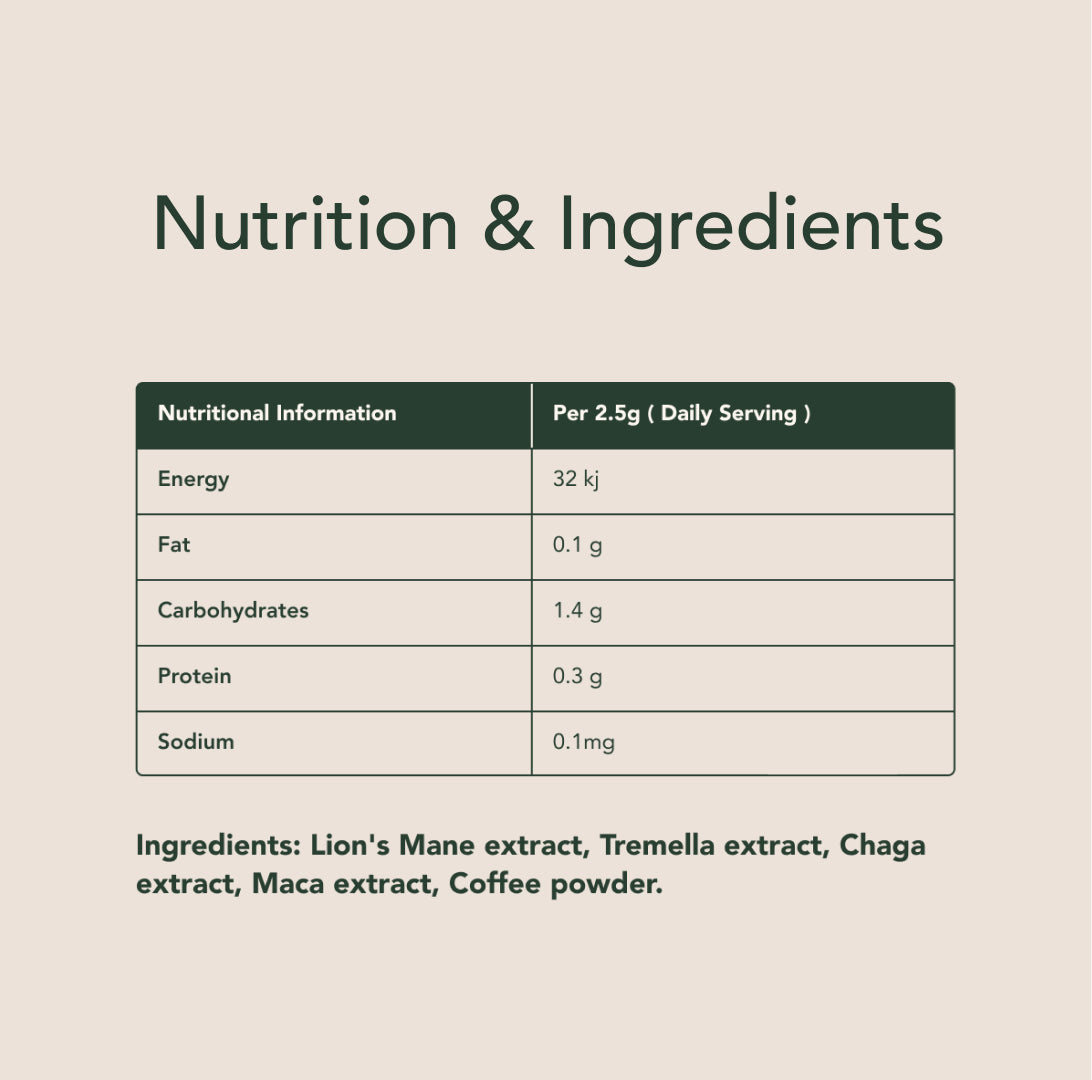
Nooni's Mushroom Coffee contains 300mg Chaga per serving, combined with Lion's Mane (450mg) for focus, Tremella (300mg) for cellular hydration, and Maca (50mg) for energy. The base is specialty-grade Arabica coffee. The result is a cup of coffee that tastes like coffee — but with a broader profile of effects.
The combination of antioxidant support (Chaga), cognitive support (Lion's Mane), and stable energy (Maca) is no accident. It's formulation.
Conclusion
Chaga isn't a miracle cure. But when it comes to antioxidant density and the scientific basis for it, it stands in a league of its own. The data is consistent — though much research is still in early stages. What is certain: extraction method and source material quality determine whether you actually get that data in your cup. Nooni's Mushroom Coffee uses exclusively 100% fruiting bodies via dual extraction, third-party tested in the Netherlands. Discover it at getnooni.com.