
Chaga has a reputation as a powerful antioxidant — but the conversation about blood sugar and insulin sensitivity often stays in the background. Yet scientific research in this area is growing steadily. Here's what the studies show so far, and what that actually means for your metabolism.
What is insulin sensitivity exactly?
Insulin is the hormone that signals your cells to take glucose from your blood. Insulin sensitivity describes how well your cells respond to that signal.
High insulin sensitivity: you need less insulin to achieve the same effect. Low insulin sensitivity — also called insulin resistance — means your body has to work harder for the same result. That puts pressure on your pancreas and can over time contribute to weight gain, fatigue, and increased risk of metabolic syndrome.
Diet, movement, and sleep are the big levers. But certain plant compounds are also increasingly being studied for their role in this system.
Chaga and glucose: the active compounds
Chaga (Inonotus obliquus) contains a broad spectrum of bioactive compounds. For metabolism, three are particularly relevant.
Beta-glucans
Beta-glucans are polysaccharides that give Chaga its immune-modulating properties. They also slow the absorption of carbohydrates in the small intestine — similar to how dietary fiber works. This leads to a more gradual rise in blood sugar levels after a meal, rather than a sharp spike.
Betulinic acid and betuline
These are triterpene compounds characteristic of Chaga — sourced from the birch bark on which the mushroom grows. Betulinic acid has caught researchers' attention because it can promote the activation of AMPK. AMPK is an enzyme that signals your cells to burn glucose more efficiently. It's the same pathway that exercise and fasting activate.
Polyphenols and antioxidants
Chaga has the highest ORAC score (a measure of antioxidant capacity) of all known food sources. Oxidative stress — an excess of free radicals — is linked to insulin resistance. By reducing oxidative stress, Chaga can indirectly support insulin sensitivity.
What does the research say?
It's important to be honest: most research on Chaga and blood sugar has so far been conducted in cell and animal studies. Large-scale human clinical trials are still lacking.
Animal studies
In several animal studies — published in journals including Phytomedicine and International Journal of Biological Macromolecules — mice with diabetes showed lower fasting blood sugar levels and improved insulin sensitivity after supplementation with Chaga extracts. The polysaccharide fractions appeared to be the most active.
One study also observed a reduction in LDL cholesterol and triglycerides — markers closely linked to metabolic health.
In-vitro findings
Cell studies suggest that Chaga compounds can stimulate glucose uptake in muscle cells via GLUT4 transporters — proteins that bring glucose into the cell. This is the same mechanism that insulin activates.
What this means for you
Direct translation to humans requires caution. What works in a mouse or petri dish doesn't automatically work the same way in a human body. Studies point in a promising direction — but Chaga is not a replacement for a doctor, medication, or a solid lifestyle foundation.
Use it for what it is: a supplement, not a solution.
The role of extraction method
Here's a crucial detail that many people overlook. Not every Chaga product delivers the same active compounds.
Beta-glucans are water-soluble and are released through hot water extraction. Triterpenes like betulinic acid are fat-soluble and require alcohol extraction. A product using only one of these methods delivers an incomplete profile by definition.
Dual extraction — water and alcohol — is the only way to make the full spectrum of bioactive compounds available. That's not marketing language, that's chemistry.
Beyond that, source matters. Chaga harvested from wild birch trees in cold climates contains higher concentrations of betulinic acid than cultivated varieties, because the compound comes from the birch bark — not from the mushroom itself.
Chaga in a broader metabolic context
Blood sugar regulation is a system. No single compound — however promising — works in isolation.
Chaga may play a role in supporting stable blood sugar levels, but that effect is strongest when it builds on a foundation of:
- Nutrition: minimal ultra-processed carbohydrates, adequate fiber and protein.
- Movement: muscle mass is the largest organ for glucose uptake.
- Sleep: one bad night already measurably lowers insulin sensitivity.
- Stress management: cortisol directly raises blood sugar.
Within that framework, Chaga can function as a meaningful supplement — particularly through its antioxidant capacity and potential support for AMPK activation.
Conclusion
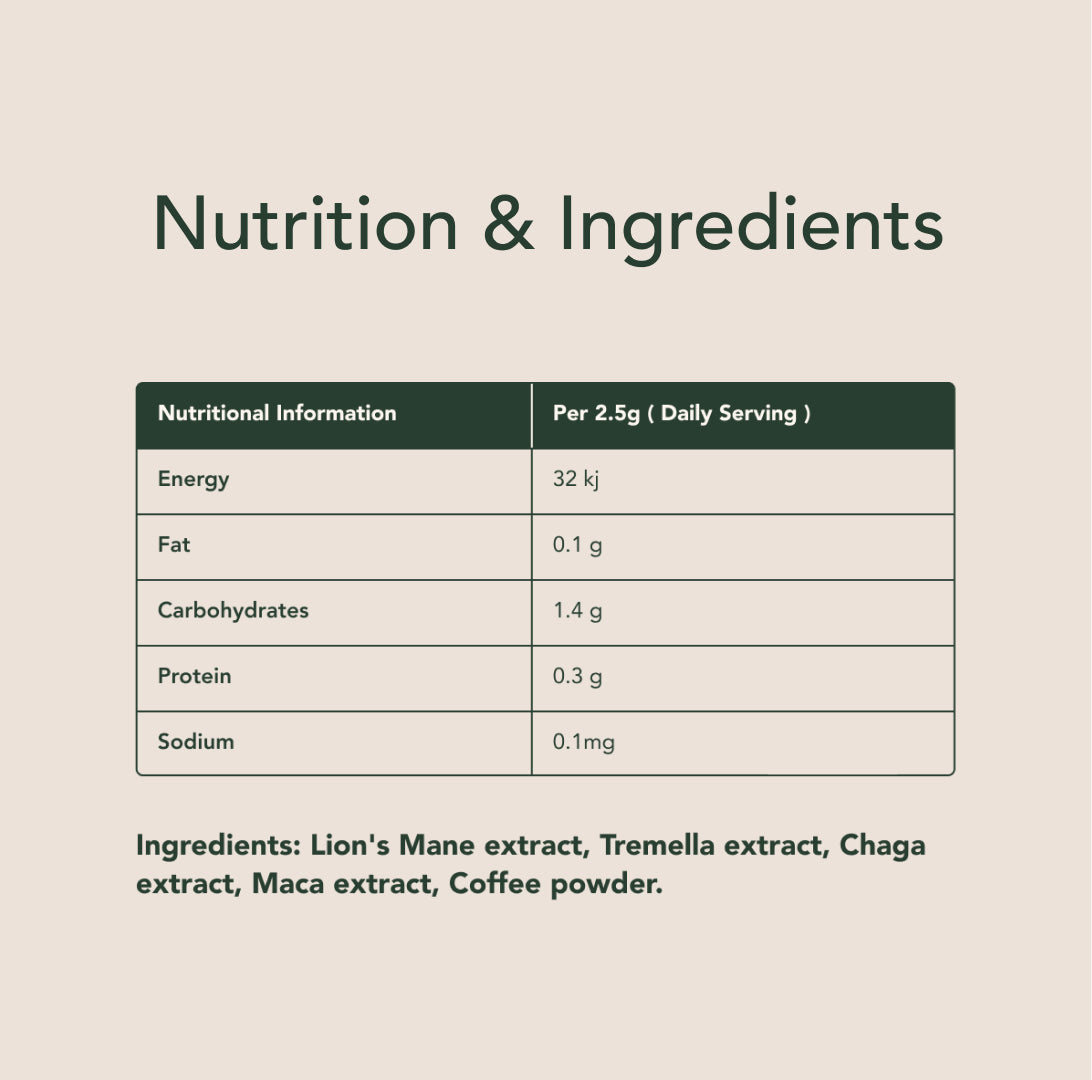
Research on Chaga and insulin sensitivity is promising, but incomplete. What we know: the bioactive compounds in Chaga — beta-glucans, betulinic acid, and polyphenols — have mechanisms relevant to metabolic health. What we also know: extract quality determines what actually reaches your body. At Nooni, Chaga is dual-extracted from 100% fruiting bodies and third-party tested for active compounds. Discover Mushroom Coffee with 300mg Chaga per serving at getnooni.com.